Humanitarian logistics planning for future flood risks: a data-driven stochastic framework
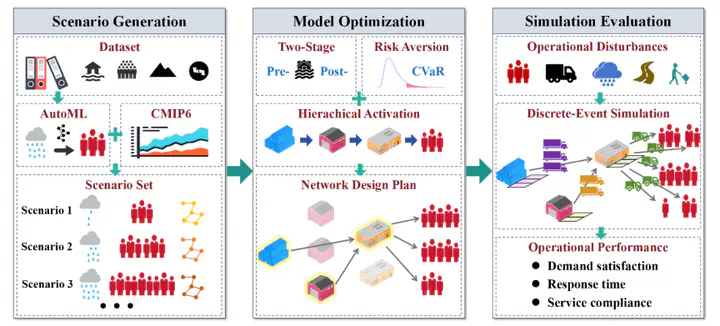 Future flood scenario, optimization, and simulation framework. Source: paper.
Abstract
This study integrates future flood-scenario generation, two-stage stochastic optimization, and discrete-event simulation for climate-resilient humanitarian logistics planning. Historical disaster data, AutoML, and CMIP6 climate projections are used to create future demand scenarios, while CVaR captures severe shortage risk. A Jianghan Plain case study shows that future-oriented, risk-averse planning can sharply reduce shortages and improve service compliance under uncertain and extreme flood conditions.
Publication
Computers & Industrial Engineering, 219, 112180
研究概览
本研究面向气候变化下不断上升的洪水风险,将未来洪水情景生成、两阶段随机优化和离散事件仿真整合到同一人道主义物流规划框架中。框架同时考虑灾前设施与库存决策、灾后调拨方案以及动态配送过程的服务质量。
核心方法与发现
- 结合 2006–2024 年历史灾情、AutoML 和 CMIP6 气候投影,构造面向 2026–2055 年的未来洪水需求情景。
- 通过包含 CVaR 风险度量的两阶段随机规划,联合决定区域仓库、库存预置、配送中心启用和物资分配。
- 江汉平原案例表明,面向未来且考虑风险规避的方案能够显著减少短缺,并在仿真中提高服务达标率。
资料来源

Ranran Chen
Ph.D. Student